
If you have been wondering what the strategies of digital marketing are, the short answer is this:
digital marketing strategies are the planned ways a business uses online channels to attract attention, build trust, generate leads and convert customers.
That sounds broad, because it is.
In practice, though, most digital marketing strategies sit under a few core pillars. These strategies work together to help businesses get found online, stay visible, and move people from first click to real enquiry or sale.
For businesses, understanding these strategies matters. It helps you make better marketing decisions, invest in the right areas, and avoid wasting time on activities that look busy but do not support real business goals.In this guide, we break down the four core strategies of digital marketing:
- SEO
- Advertising
- Social Media
- Email Marketing
Each one plays a different role. The best results usually come when they are planned together, rather than treated as separate tasks.
Understanding the 4 Main Digital Marketing Strategies
Digital marketing strategies are the approaches businesses use to promote themselves online in a clear, measurable and purposeful way.
Rather than relying on one-off tactics, an effective digital marketing strategy looks at the bigger picture:
- Who you are trying to reach
- Where they spend time online
- What they need to see before they trust you
- What action you want them to take
- Which channels are most likely to help make that happen
That is why digital marketing is not just about posting on social media or running a few ads. It is about choosing the right mix of activities to support your goals.
For most businesses, that mix comes back to four core strategies.
1. SEO
SEO, or search engine optimisation, is one of the most important digital marketing strategies because it helps your business appear in search results when people are actively looking for what you offer.

This is often one of the strongest long-term strategies because it targets intent. Someone searching for a service, solution or question is already showing interest. Our job is to help your website appear in the right searches and provide a page that meets that need.
What SEO includes
SEO is more than just keywords. A good SEO strategy includes:
- keyword research
- competitor analysis
- service page optimisation
- location page optimisation
- blog content
- internal linking
- on-page optimisation
- technical improvements
- local SEO and Google Business Profile optimisation
Why SEO matters
SEO helps businesses build visibility over time. It can support both awareness and lead generation, depending on the type of pages being optimised.
For example:
- A service page may target someone ready to enquire
- A blog may target someone researching a topic
- A location page may help a business rank for local service searches
When SEO is done well, it creates content with a clear purpose. It is not about publishing for the sake of it. It is about matching content to what people are actually searching for and what the business wants to achieve.
Where businesses often get SEO wrong
A common mistake is assuming SEO is just blogging. Another is focusing only on rankings without considering whether the traffic is relevant.
Strong SEO should connect search intent with business goals. That means understanding not just how to bring people to the site, but which pages should attract them and what those pages need to do next.
Why AEO is becoming part of SEO
Another area businesses should now be aware of is AEO, or answer engine optimisation.
AEO is about structuring your content so it is easier for search engines and AI-driven search experiences to understand, extract and surface as a direct answer.
As search behaviour changes, people are asking longer, more specific questions and expecting clearer answers. Search platforms are also placing more focus on helpful, well-structured content that directly addresses what someone wants to know.
For businesses, this means strong SEO content should not only target keywords. It should also answer real questions clearly, use logical headings, and make key information easy to find. In practice, that could mean building out FAQ content, writing more directly, improving page structure, and covering topics in a way that feels genuinely useful and human.
AEO is not a separate channel that replaces your SEO strategy. It is better thought of as an evolution in how content is written and organised.
The businesses that do this well are often the ones making it easier for both users and search engines to understand what they offer and why it matters.
2. Advertising
Advertising is the strategy that helps businesses gain visibility faster by paying to appear in front of the right audience.
This can include:
- Google Ads
- Meta Ads
- LinkedIn Ads
- YouTube Ads
- remarketing campaigns
- display advertising
Unlike SEO, which usually takes time to build, advertising can start generating traffic and data much sooner. That makes it useful for businesses launching new services, promoting offers, testing messaging or entering competitive markets.
What advertising is really for
A lot of businesses think advertising is just about immediate leads. Sometimes it is. But it can also support other goals, such as:
- building brand awareness
- driving traffic to a landing page
- promoting valuable content
- retargeting past website visitors
- staying visible during a decision-making period
A good advertising strategy is not just about getting clicks. It is about making sure those clicks are relevant and that the page they land on is set up to convert.

Why messaging and landing pages matter
Even a strong ad campaign can underperform if the landing page is weak.
If the ad’s messaging does not match the page, or the page is unclear, visitors may leave without taking action. That is why advertising works best when it is connected to the wider marketing system, including your website, offer and follow-up strategy.
The role of remarketing
Remarketing is often one of the most practical advertising strategies because it targets people who have already engaged with your business.
That might include people who:
- visited your website
- viewed a service page
- clicked an ad
- opened an email
- interacted with your social content
Rather than starting from scratch, remarketing helps bring interested users back into the conversation. It can be especially useful for service-based businesses where people do not always convert on the first visit.
3. Social Media
Social media is the digital marketing pillar that helps businesses stay top of mind, build an online community and create an ongoing connection with their audience.
For some businesses, social media directly supports leads and sales. For others, its role is more about trust, credibility, and awareness until someone is ready to act.
What social media can support
A strong social media strategy can help with:
- brand awareness
- audience engagement
- showcasing work
- educating potential customers
- building trust through consistency
- driving traffic to your website or landing pages
It can also support your other marketing channels. For example, social content can amplify blog content, support paid campaigns, and help people become more familiar with your business before they enquire.
What makes social media strategic
Social media becomes a strategy when it has a role beyond posting for the sake of posting.
That means asking:
- what do we want this content to achieve?
- who is it for?
- how does it support our other activity?
- what kind of action or response are we hoping for?
Without that thinking, social media can quickly become reactive rather than useful.
4. Email Marketing
Email marketing is one of the most valuable digital marketing strategies because it gives businesses a direct way to stay in touch with their audience.
Unlike social platforms or search engines, email is a channel you own. That makes it especially useful for nurturing leads, building repeat engagement and staying connected over time.
What email marketing can include:
Email marketing can support:
- lead nurture sequences
- welcome emails
- promotional campaigns
- monthly newsletters
- abandoned enquiry follow-up
- re-engagement campaigns
- educational content wrappers
- client retention activity
It is often one of the strongest channels for moving people from interest to action, especially when the timing and messaging are right.

Why email works so well
Not everyone enquires the first time they visit a website. Some people need more time, more information or more trust before they are ready to take the next step.
Email marketing helps bridge that gap.
It allows businesses to stay useful and relevant without relying on someone to search again or remember to come back later.
Why email is often underused
Many businesses collect email addresses but do very little with them. Others only send emails when they have something to sell.
A better approach is to treat email as an ongoing relationship channel. When used properly, it can support awareness, trust, conversion and loyalty long after the first website visit.
A Real World Case Study
An example of the power of a solid Email Marketing flow occurred recently at our agency, with a long-term client of ours.
They had been running an Abandoned Cart flow, which was ongoing for years and performing really well. However, we recently updated the flow to be more in line with their modern branding and messaging. The next month, we reported that the revenue from this flow had grown to 208% compared to the month before.
This conversion rate has continued at this higher rate and the clients are continuing to benefit off this increase every month since.
This demonstrates the impact of a strong, comprehensive campaign delivered over the right channel.
Why These Strategies Work Best Together
Each digital marketing strategy has its own role, but the strongest results usually come when they work together.
For example:
- SEO helps people find your business
- Advertising helps increase reach and target key audiences
- Social media builds community and trust
- Email marketing helps nurture and re-engage people over time
A person might first discover your business through a Google search, then follow you on social media, click a remarketing ad later, and eventually convert after receiving an email. That is why digital marketing works best as a connected system, not as separate activities.
Which Digital Marketing Strategy Should Come First?
That depends on the business.
There is no single order that suits everyone. The right starting point usually depends on:
- Your goals
- Your timeline
- Your budget
- Your current website
- How people buy from you
- Whether you need short-term leads, long-term visibility, or both
For some businesses, SEO should be the priority. For others, paid advertising may help generate faster momentum while longer-term organic work builds in the background. Some may need stronger social proof and content first. Others may benefit most from setting up email nurture and remarketing to make existing traffic work harder.
The point is not to do everything at once. It is to understand the role of each strategy and build one that suits your stage of growth.
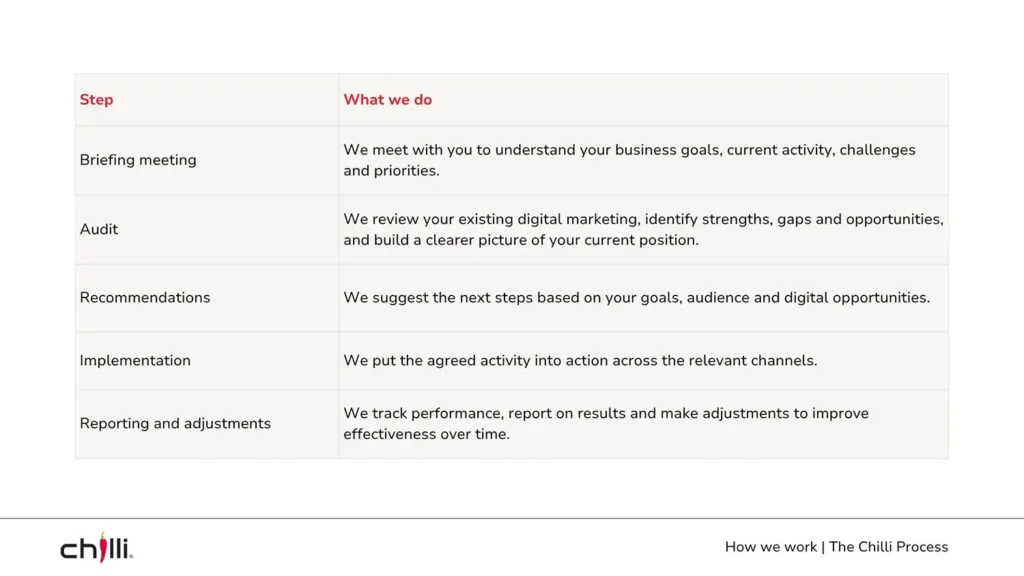
How We Work at Chilli
At Chilli, we approach digital marketing as an ongoing process, not a one-off task. We start by getting clear on the business itself, including your goals, your current marketing activity, what is already working and where the gaps may be.
From there, we complete an audit to review the current digital position. This may include your website, search visibility, advertising activity, social media presence, email marketing, content and overall messaging. The goal is to understand what is happening now before recommending what should happen next.
Once we have that clarity, we map out the next steps. That means identifying the channels, priorities and opportunities that best align with your goals, rather than suggesting activity for the sake of it. From there, we move into implementation, whether that involves SEO, advertising, social media, email marketing, content, website improvements or a mix of services.
As the work rolls out, we continue to measure performance, report on progress and refine the approach where needed. That way, the strategy stays active, informed and responsive, rather than sitting in a document untouched.
The Chilli process
FAQs
What are the main strategies of digital marketing?
The main strategies of digital marketing often include SEO, paid advertising, social media marketing and email marketing. These strategies help businesses attract, engage and convert customers online.
Which digital marketing strategy is best?
There is no single best strategy for every business. The right approach depends on your goals, audience, timeline and budget. Many businesses benefit from a mix of strategies rather than relying on just one.
Is SEO part of digital marketing?
Yes. SEO is one of the core strategies of digital marketing. It helps businesses improve their visibility in search engines and attract relevant traffic over time.
Is email marketing still important?
Yes. Email marketing remains valuable because it gives businesses a direct way to stay in touch with leads and customers. It can support nurturing, re-engagement and repeat business.
Do I need social media for digital marketing?
Not every business needs to be active on every social platform, but social media can play an important role in building familiarity, trust and visibility. The key is choosing the platforms that suit your audience.
Can digital marketing strategies work together?
Yes. In fact, they usually work best when they do. SEO, advertising, social media and email marketing often support different stages of the customer journey and become stronger when planned as part of one connected strategy.