

AEO stands for Answer Engine Optimisation.
In simple terms, it’s about making sure your business shows up in AI-generated answers, not just traditional search results.
Instead of users clicking through a list of blue links, platforms like ChatGPT, Google AI Overviews, Gemini and Perplexity now deliver direct answers. That means your content needs to be structured, trusted and clear enough for AI to select and cite it.
This shift is not a small update. It’s one of the biggest changes to search behaviour we’ve seen. If you’re interested in showing up in Answer Engines, we’ve read all of the most recent articles from industry leaders, so you don’t have to.

Why AEO Matters Now
Search is no longer just about rankings.
With the rollout of AI Overviews in Google Search, users are getting answers before they even see traditional results. In many cases, they don’t need to click through at all.
This changes how visibility works.
Instead of competing for Position 1 on Google, you’re now competing to be:
- Referenced in an AI summary
- Quoted as a trusted source
- Selected as the most relevant answer
If your content is not structured for this, it can be skipped entirely.
See the example below of the AI Overview feature
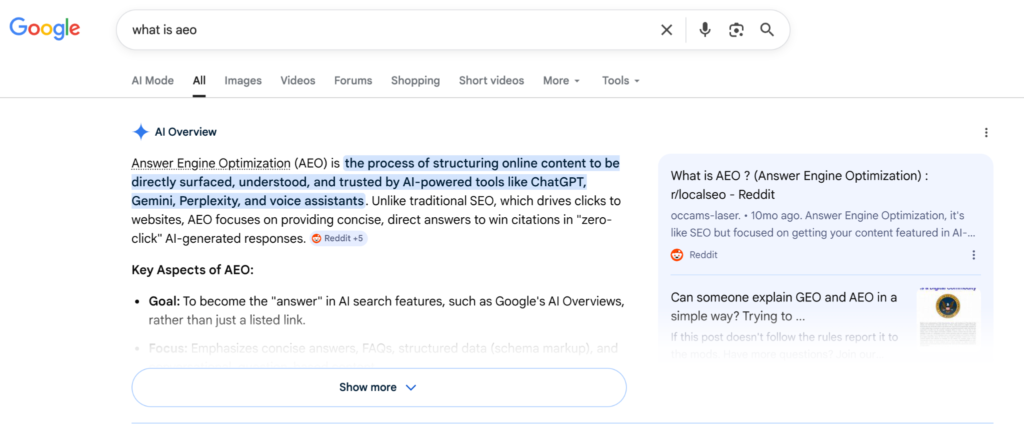
How AI Search is Changing User Behaviour
The biggest shift is not just technology. It’s behaviour.
Users are now:
- Asking longer, more conversational questions
- Expecting instant, complete answers
- Clicking less, especially for informational searches
This means fewer opportunities to win traffic through traditional rankings alone.
Instead, visibility comes from:
- Being cited in AI responses
- Owning key questions in your niche
- Providing clear, structured information
The Impact on SEO and Paid Campaigns
We are already seeing measurable changes across campaigns.
Cost per click is rising
With fewer clicks available, competition increases. Advertisers are paying more to secure the same level of traffic.
Position 1 is losing clicks
Historically, Position 1 captured the majority of clicks. With AI Overviews now sitting above it, that share is shrinking.
AI is intercepting users earlier
Users are getting answers at the very start of their journey, meaning fewer visits to websites during the research phase.

What We’re Seeing Across Paid Campaigns
At Chilli, we’ve been tracking how AI search is impacting performance across multiple industries.
Since October last year, we’ve seen a clear shift:
Average cost per click has increased by 76 cents across the accounts that Chilli manage.
This statistic covers a broad range of industries and spend levels. This is not isolated to one industry or campaign type. In some industries with higher informational intent keywords, we are seeing the average CPCs increase by more than 76 cents.
Although gradual, this increase in CPC is making Google Paid Search more difficult for some of our customers.
Why CPC Is Increasing
This trend aligns with what we’re seeing in AI-driven search behaviour.
Fewer clicks available
With AI Overviews answering queries directly, fewer users are clicking through to websites. That reduces the total pool of available clicks.
Increased competition for the remaining traffic
As clicks become more limited, more advertisers are competing for the same traffic, which naturally drives costs up.
Higher intent clicks remain
The clicks that do come through are often further down the decision-making journey, making them more competitive and more expensive.
Adapting Google Ads for AI Search
To improve visibility within AI-driven search, our strategy is evolving alongside Google’s own systems.
At Chilli, we stay up to date with the latest developments and releases from Google to ensure our clients’ marketing strategies continue to evolve with the digital landscape. By adapting campaigns to align with changing search behaviour, emerging AI technologies, and new advertising features, we help businesses remain visible across Google’s ecosystem. This forward-thinking approach allows us to embrace new opportunities as they emerge and keep campaigns performing in an increasingly AI-driven environment.

How to Optimise for AEO Organically
With industry leaders all releasing their guides to ranking in AI Search it is difficult for business owners or marketing managers to know where to start. Please find below the 10 point summary we have put together from leading industry advice, including SEMrush, HubSpot, and Ahrefs.

1. Check what AI already says about the brand
Start by searching the brand, services and key questions in tools like ChatGPT, Gemini, Perplexity and Google AI Overviews.
Look for:
- Is the brand mentioned?
- Is the information correct?
- Are competitors being mentioned instead?
- What sources are being cited?
Ahrefs recommends starting with existing AI mentions, then identifying where the brand is missing or misrepresented.
2. Fix brand inconsistencies first
AI can pull from websites, directories, social profiles, review platforms and third-party mentions. Make sure core brand details are consistent across the web. Consistency is the key.
Check:
- Business name
- Services
- Location
- Tagline
- About section
- Team and expertise
- Contact details
Ahrefs notes that incorrect AI answers often come from limited website information, inconsistent assets, third-party misrepresentation or unreliable sources.
3. Build content around real questions
AEO content should target the exact questions people are now asking Google Search and AI tools.
For example:
- What is AEO?
- How does AEO work?
- Is AEO replacing SEO?
- How do I optimise for AI search?
- How do I show up in Google AI Overviews?
Semrush recommends using related queries, prompt research and related search terms to find the questions your audience is already asking.
4. Answer the question immediately
Each section should open with a clear, direct answer before expanding.
For example:
What is AEO?
AEO, or Answer Engine Optimisation, is the process of structuring website content so AI search tools can understand, trust and use it in direct answers.
Then add context, examples and next steps underneath.
Ahrefs recommends using question-based headings followed by concise answers, while keeping enough depth for human readers.
5. Use clear, structured writing
AI tools need content, website structure, and relevant website code that it can easily read.
Use:
- Short paragraphs
- Clear H2s and H3s
- Tables where useful
- FAQs
- Direct statements
- Simple subject, verb, object sentence structures
HubSpot recommends naming the topic plainly, writing complete paragraphs and using short factual claims to reduce confusion.
6. Add original insight
Generic content is less likely to stand out.
Add:
- Your own original data
- Industry trends
- Client examples
- Before and after examples
HubSpot calls this “information gain”, meaning original data, examples and a clear point of view that makes content more useful than generic advice.
7. Strengthen trust signals
AEO still depends on credibility.
Add:
- Author bio
- Last updated date
- Internal links
- External citations
- Case studies
- Testimonials
- Schema markup (website code)
- Clear business information
HubSpot recommends schema, author pages, credible citations and internal links as trust signals that help content get quoted.
8. Improve technical foundations
AEO does not replace technical SEO.
Check:
- Pages are crawlable
- Site speed is strong
- Content is not hidden behind heavy JavaScript
- Internal linking is logical
- Schema is implemented
- FAQs use FAQ schema where appropriate
- Local pages use Local Business schema
Ahrefs recommends schema types such as Article, FAQPage, HowTo, Local Business and Speakable to help search systems understand content.
9. Build authority beyond the website
AI engines also consider how the wider web talks about a brand.
Focus on:
- Backlinks
- Digital PR
- Directory listings
- Review platforms
- Industry mentions
- Co mentions with trusted brands
- Local citations
Ahrefs notes that off-site signals, backlinks, citations, third-party platforms and co-mentions can help AI systems recognise and cite a brand.
10. Measure AEO separately from SEO
AEO success is not only measured by clicks.
Track:
- AI citations
- Brand mentions in AI answers
- Referral traffic from AI tools
- Changes in impressions vs clicks
- Queries where competitors appear but you do not
- Conversion quality from AI-driven traffic
HubSpot recommends tracking share of answer, AI visibility and the gap between impressions and clicks.
At Chilli, we are staying on top of all AI Search-related content so you don’t have to. If you would like to get involved in the biggest change in Search, contact us today and secure your 45-minute free strategy session!
FAQs
How do I know if my business is showing up in AI search?
You can test this by searching your brand, services and common customer questions in tools like Google AI Overviews, ChatGPT, Gemini and Perplexity. Look at whether your business appears, whether the information is accurate and which competitors are being mentioned. Chilli Group can help build a report for you in Google Analytics to understand where your AI traffic is landing!
Can Google Ads appear in AI search?
Yes. Google is continuing to integrate ads into AI driven search experiences. At Chilli, we stay up to date with the latest releases from Google to keep our clients’ marketing strategies evolving with the digital landscape. By adapting to changing search behaviour, AI technologies, and new advertising features, we help businesses stay visible and competitive online.