
If your website is hard to use on a phone, it can affect more than just the user experience.
It can affect how people view your business, how easily they find what they need, and whether they take the next step.
For many businesses, mobile is now the first way people interact with a website. They might be searching for a service, comparing providers, checking your credibility, or trying to contact you quickly.
That is why mobile SEO optimisation matters.
It is not just about making a website fit a smaller screen. It is about making sure your website works properly for real people on mobile devices and supports your search visibility at the same time.
At Chilli, we often see businesses put time into content, design and SEO, but still lose opportunities because the mobile experience has been overlooked. A site can look fine on desktop and still create friction on mobile. When that happens, users are less likely to stay, engage or enquire.
What is mobile SEO optimisation?
Mobile SEO optimisation is the process of improving your website, so it performs well on mobile devices and gives users a smooth, easy experience.
That includes things like:
- how quickly pages load
- how easy the content is to read
- how simple the navigation is to use
- how well buttons, forms and links work on a phone
- how clearly your pages are structured for both users and search engines
In simple terms, it is about making sure your website is mobile friendly in a way that supports both usability and SEO.
A lot of businesses assume mobile SEO is covered if their website technically opens on a phone. But that is only the starting point. A page might load on mobile and still be slow, cluttered, hard to read or difficult to use.

Why mobile SEO matters for businesses
Mobile SEO matters because people expect quick answers and easy experiences when they use their phones.
They are not usually sitting down to carefully study every page of your website. They are scanning, comparing and deciding whether your business looks worth contacting.
If your site feels frustrating on mobile, that decision can happen very quickly.
Mobile is often the first impression
For many businesses, mobile is where first impressions are formed.
A potential customer might search while they are on the go, during a lunch break, after work, or while comparing businesses from the couch. If your site is slow, hard to navigate or difficult to read, it can create doubt before they have even looked into what you offer.
Mobile affects action
A mobile visitor is often closer to taking action than a casual browser on desktop.
They may want to:
- call your business
- submit an enquiry
- request a quote
- find your location
- check whether you service their area
- compare you with another provider
If those actions are awkward on mobile, the website becomes a barrier instead of a support.
Mobile supports stronger SEO overall
Mobile SEO is also part of your wider SEO performance. Search engines want to deliver pages that are useful, accessible and easy to use. If your mobile site creates a poor experience, that can work against the visibility of your pages over time.
That does not mean mobile SEO is a magic fix. But it is a practical part of building a website that performs properly.
What a mobile-friendly website should do well
A mobile-friendly website should help users get what they need quickly and comfortably.
That usually means it should:
- load without unnecessary delay
- display properly on different screen sizes
- use text that is easy to read
- make it easy to tap buttons and links
- keep menus simple and clear
- make contact options obvious
- guide users to the next step without confusion
These sound basic, but they are often where businesses lose people.
Common mobile SEO problems businesses overlook
A lot of mobile SEO issues are not dramatic. They are small points of friction that build up across the website.
Slow page speed
If a page takes too long to load on mobile, users may leave before they even see the content.
This often comes down to things like oversized images, unnecessary scripts, bloated page builders or outdated design elements. Even a visually strong website can feel frustrating if it is heavy and slow on mobile.
Content that is hard to scan
What works on desktop does not always work on a phone.
Long paragraphs, oversized headings, awkward spacing or cluttered layouts can make mobile content harder to read. People need to be able to scan quickly and understand the page without effort.
Menus that create friction
Some mobile menus are too busy, too hidden or too difficult to use. If users cannot quickly find your services, contact details or important pages, they may leave rather than keep digging.
Buttons and forms that are difficult to use
If buttons are too small, too close together or hard to tap, that affects usability straight away. The same goes for forms that ask for too much, do not display properly on a phone, or take too long to complete.
Important information hidden on mobile
Sometimes the mobile version of a page strips back too much. Businesses hide text, remove sections or simplify layouts so much that the page loses important information. That can weaken both the user experience and the SEO value of the page.
Mobile first indexing in simple terms
You do not need to get too technical here, but it is useful to understand the principle.
Search engines now place strong importance on the mobile version of a website. That means your mobile content is not secondary. It needs to carry the same core value as your desktop version.
For business owners, the key takeaway is simple: your mobile website needs to be complete, clear and functional.
If your desktop website has stronger content, better structure or more useful information than your mobile version, that gap can create issues.

Responsive design vs separate mobile versions
Most modern business websites use responsive design. That means the same site adjusts to different screen sizes rather than creating a separate mobile website.
In most cases, this is the most practical setup because it helps keep your content, layout and SEO signals more consistent across devices.
Older sites sometimes rely on separate mobile versions or clunky workarounds. These setups can create more room for inconsistency, especially when content is not matched properly between desktop and mobile.
For most businesses, the goal should be a website that adapts well across devices without removing important content or functionality
7 Mobile SEO best practices for business websites
If you are reviewing your website, these are some of the main areas to focus on.
1. Improve mobile page speed
A slow mobile site creates friction immediately.
Review large images, heavy scripts, unnecessary plugins and anything else that may be slowing down load time. Sometimes improving speed is less about redesigning everything and more about removing what is not needed.
2. Keep the layout clear and simple
Your mobile layout should support quick understanding.
That means:
- clear headings
- shorter paragraphs
- enough spacing between sections
- obvious calls to action
- visual hierarchy that makes sense on a small screen
3. Make navigation easy
People should not have to work hard to find your key pages.
Your mobile navigation should help users get to services, contact details, location information and important pages quickly. If the menu feels crowded or confusing, it may need simplifying.
4. Check tap targets and usability
Buttons, links and form fields should be easy to use on a phone.
This is one of those details that can seem minor until it affects real users. If people are tapping the wrong thing or struggling to complete a form, the site is not doing its job.
5. Make content easy to read
A mobile page should feel easy to consume.
Use short paragraphs, plain language and headings that guide the reader through the page. If the content looks dense or tiring on mobile, it may need restructuring.
6. Keep important content on mobile
Do not strip back so much that the mobile page loses substance.
Your services, key value points, contact details and helpful supporting content should still be available on smaller screens. A cleaner mobile layout is good. A thinner version of the page is not always helpful.
7. Avoid interruptions that get in the way
Pop ups, overlays and banners can quickly become frustrating on mobile, especially when they block the content or are hard to close.
Used carefully, they may still have a place. But if they interrupt the user journey too early or too aggressively, they can do more harm than good.
Technical mobile SEO still matters
Even though user experience is a big part of mobile SEO, there is still a technical side that matters.
This includes things like:
- making sure search engines can access important page resources
- keeping title tags and meta descriptions relevant and clear
- using structured data properly where relevant
- avoiding broken layouts or rendering issues on mobile
- keeping content and metadata consistent across devices
Business owners do not always need to manage this side themselves, but it is worth knowing that mobile SEO is not only visual. What sits behind the page also plays a role.
How mobile SEO affects local businesses
Mobile SEO is especially important for local and service-based businesses.
A person searching for a dentist, electrician, accountant, marketing agency or builder is often using their phone. They may want quick, practical information before deciding who to contact.
That includes:
- what you do
- where you are
- whether you service their area
- how to contact you
- whether your business looks credible and current
If your mobile website makes that easy, it supports better outcomes. If it creates friction, the user may move on quickly.
For Sunshine Coast businesses in particular, this matters because local competition is often strong. A good mobile experience helps support trust when people are comparing local options.
A practical way to think about mobile SEO
One of the easiest ways to assess your mobile SEO is to stop thinking like the business owner and start thinking like the user.
Ask questions like:
- Can I understand what this business does within a few seconds?
- Can I find the main service pages easily?
- Is the text comfortable to read on my phone?
- Can I call or enquire without effort?
- Does the website feel current, clear and trustworthy?
If the answer is no to any of these, there is probably work to do.
As Stella, Chilli Account Manager and SEO Specialist at Chilli, puts it:
“Mobile SEO is not just about making a site fit a smaller screen. It is about making sure people can actually use your website easily when they are ready to take action. If the mobile experience feels slow, cluttered or hard to navigate, that can affect both trust and performance.”
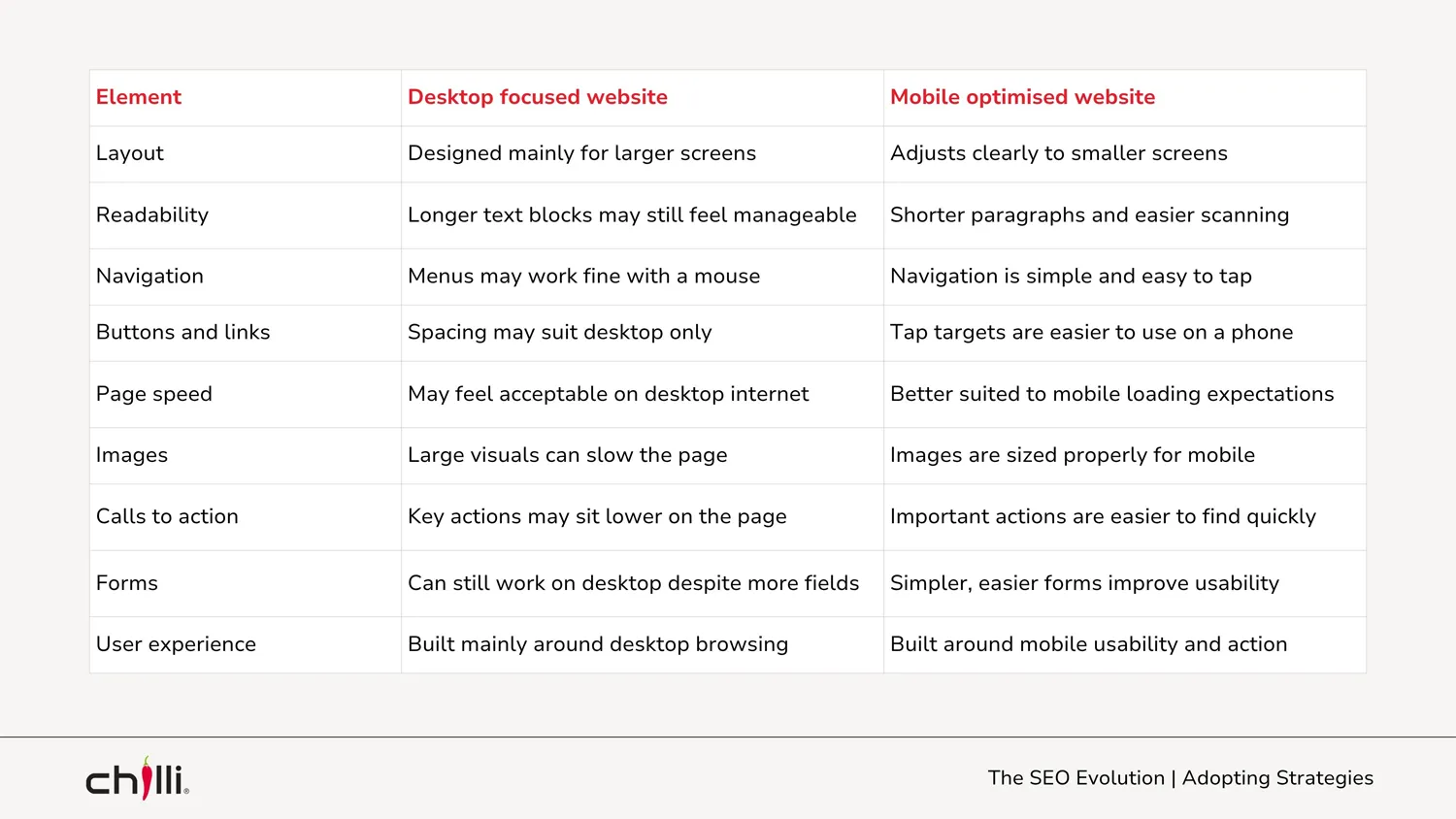
Desktop vs mobile SEO: what is the difference?
A website can work reasonably well on desktop and still fall short on mobile. That is why mobile SEO deserves its own attention.
Mobile SEO checklist for business websites
If you want a practical place to start, use this checklist to review your site.
12 things to check on your website
- Does your website load quickly on mobile?
- Is your site using responsive design?
- Is the text easy to read without zooming in?
- Are buttons and links easy to tap on a phone?
- Can users find your contact details quickly?
- Are pop ups or overlays getting in the way of content?
- Does your mobile site include the same important content as desktop?
- Are your images sized properly for mobile?
- Is your navigation simple and easy to use?
- Are forms easy to complete on a smaller screen?
- Are your key pages working properly on mobile devices?
- Have you tested your site on real phones, not just desktop previews?
FAQs about mobile SEO optimisation
What is mobile SEO optimisation?
Mobile SEO optimisation is the process of improving your website so it works well on phones and tablets while also supporting search visibility. It covers usability, speed, layout, navigation and technical setup.
Why is mobile SEO important for businesses?
Because many users first interact with a website on their phone. If the mobile experience is poor, it can affect trust, engagement and the chance of an enquiry or sale.
Is mobile SEO different from regular SEO?
It is part of SEO, but it focuses specifically on how your website performs on mobile devices. That includes both user experience and the way mobile pages are structured and presented.
Does my mobile site need the same content as desktop?
In most cases, yes. Your mobile site should still include the important content users and search engines need. Removing too much can create gaps in both usability and SEO.
Is responsive design enough for mobile SEO?
Responsive design is a strong starting point, but it is not the whole picture. You also need to look at speed, readability, navigation, forms and how easy the site is to use.
Can mobile SEO affect enquiries?
Yes. If people cannot use your website comfortably on their phone, they may leave before they call, submit a form or explore your services.
How do I know if my website has mobile SEO issues?
Review it on your own phone and ask a few simple questions. Is it fast, clear, easy to read and easy to use? You can also look at mobile performance through website tools and analytics, but user experience is a good place to start.
Do I need a new website to improve mobile SEO?
Not always. Some websites can be improved through updates to layout, content, images, forms and functionality without requiring a full rebuild.
How Chilli can help improve your mobile SEO
Mobile SEO optimisation is not about chasing trends or making technical changes for the sake of it. It is about making sure your website works properly for the people using it.
For businesses across the Sunshine Coast and Australia, that means creating a mobile experience that is clear, easy to use and strong enough to support the next step. Whether that next step is a call, an enquiry, a quote request or simply staying on the page longer, mobile usability plays a bigger role than many businesses realise.
If your website has not been reviewed through a mobile lens recently, now is a good time to look at it properly. If you want help understanding where your site may be creating friction, contact us to see how we can help.